
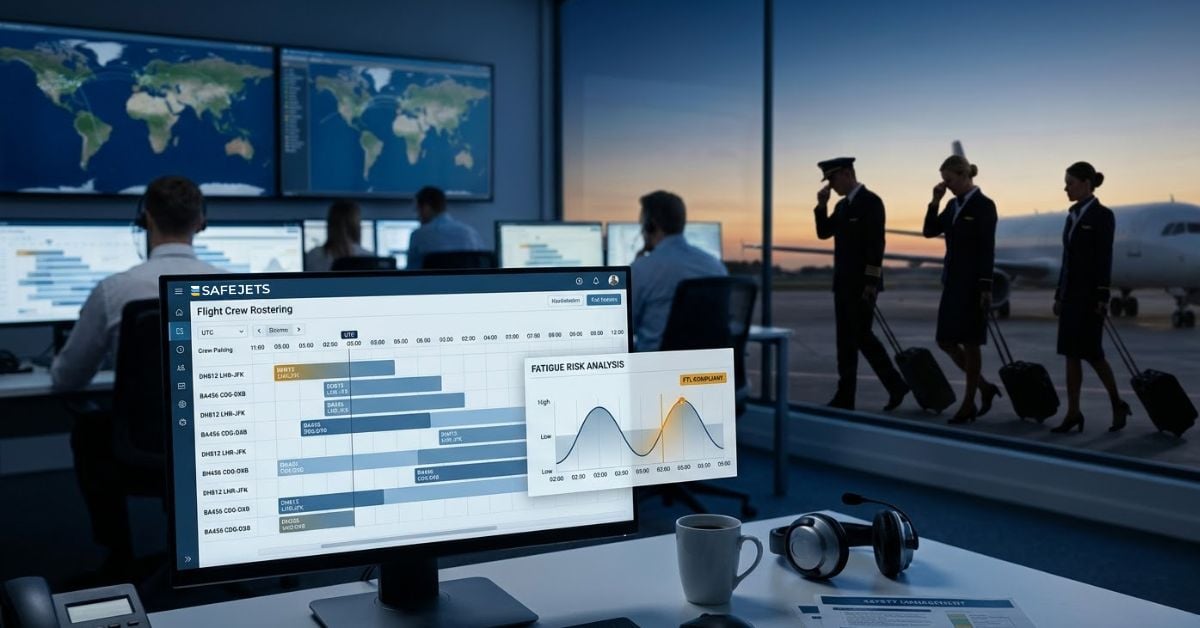
Rostering vs. Reality:When Legal Flight Time Limitations Limits Still Produce Fatigued Crews

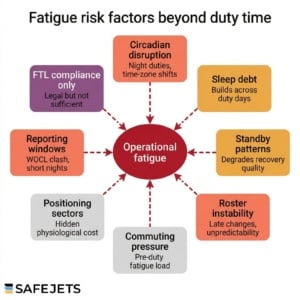
Flight Time Limitations set essential boundaries for crew duty and rest, but they do not guarantee that crews will always be fully alert in every operational context. A roster can be fully compliant on paper and still leave crews operationally tired. That gap matters because fatigue risk is not created by duty time alone; it emerges from the interaction of reporting windows, circadian disruption, cumulative sleep debt, airport standby, positioning, commuting pressure, and repeated schedule changes.
International Flight Time Limitations frameworks were designed to define limits, not to ensure individual fitness for duty in all situations. This is why operators who treat Flight Time Limitations as the endpoint of planning often discover that compliance does not automatically mean crews are fit to operate.
For SAFEJETS users, the practical question is not only whether a pairing is compliant, but whether the scheduling system, fatigue reporting process, and Safety Management System are effectively working together to identify and reduce hidden fatigue exposure before it turns into a safety event.
Under EASA ORO.FTL, ICAO Annex 6 principles, and comparable FAA fatigue provisions, the regulatory objective is to manage the risk associated with crew duty and rest. Yet these rules are necessarily generalised. They use prescriptive limits for flight duty periods, cumulative duty, minimum rest, split duty, standby, and augmented operations because regulators need enforceable standards. In practice, however, the same duty can be experienced very differently depending on acclimatisation, sleep opportunity, workload, time-zone transition, and the number of consecutive disruptive duties. That is the core reason a compliant roster may still produce a fatigued crew member.
Why Regulatory Compliance Is Necessary But Not Sufficient ?
Prescriptive Flight Time Limitations schemes define what is legally acceptable, but they do not measure whether restorative sleep actually occurred. A minimum rest period may satisfy the rule while providing inadequate sleep opportunity once transport, meals, personal needs, and circadian low points are considered. A late finish followed by an early report can be lawful under some conditions and still create substantial sleep restriction. Recurrent standby patterns are another weak point: even where standby credits and conversion rules are correctly applied, uncertainty itself can degrade recovery and increase fatigue before the duty even starts.
EASA has long recognised this limitation by requiring operators to address fatigue through a broader management framework and, where applicable, a Fatigue Risk Management approach integrated into the SMS. ICAO promotes the same logic: prescriptive limits provide a baseline, while data-driven monitoring is needed to capture operational reality. In other words, Flight Time Limitations compliance manages exposure to a threshold, but fatigue safety depends on how real crews experience the roster.
Several operational features commonly create the mismatch between roster legality and crew alertness. Consecutive duties that touch the Window of Circadian Low, frequent sector changes, disrupted acclimatisation, high workload turnarounds, and repeated roster instability all increase fatigue probability without necessarily breaching any hard limit. Positioning sectors can also be underestimated. When a crew member spends hours deadheading before operating a commercial sector, the legal treatment may differ by jurisdiction and scheme, but the physiological cost is still real. The same applies to reserve patterns that erode sleep quality even if the activated duty remains technically compliant.
What Operators Should Monitor Beyond The Roster Engine ?
For a safety-focused operator, the real control point is not the rule set alone but the combination of planning data, operational feedback, and post-duty evidence. A robust process should connect the roistering function with occurrence reporting, fatigue reports, sickness trends, unstable approach data, and operational disruptions. When these data streams are reviewed together, patterns become visible: a certain pairing family, report window, hotel location, or delayed turnaround may repeatedly produce fatigue reports despite clean compliance outputs.
This is where software implementation matters. A scheduling module should not simply validate FDP and rest minima; it should help the operator identify cumulative risk drivers. Practical indicators include recurrent duties encroaching on biological night, compression between release and next report, excessive notification volatility, and pairings with a history of fatigue reports. In an SMS environment, these indicators support hazard identification and allow targeted mitigation before the issue escalates into a line operation threat.
International guidance increasingly supports this layered approach. ICAO fatigue management material emphasises scientific principles, operational experience, and continuous monitoring. EASA rules similarly expect operators to demonstrate effective management, not only formal compliance. For reference during policy review, operators often map their procedures against regulatory material and internal standards hosted in controlled documentation systems . The principle is simple: if scheduling outputs are not feeding safety intelligence, the organisation is only managing legality, not fatigue risk.
From Compliant Schedules To Defensible Fatigue Risk Control
The most effective improvement is to treat fatigue as an operational performance variable rather than an exception raised only after a complaint. That starts with roster design. Pairings should be tested not just against maximum FDP but against realistic sleep opportunity, circadian placement, transition burden, and disruption sensitivity. Recovery periods should be assessed for quality, not merely duration. Where the operation involves long-haul, night freight, offshore support, or high-frequency short-haul sectors, generic assumptions should be replaced with route- and duty-specific analysis.
Equally important is a just reporting culture, if crews believe that fatigue reports create stigma or administrative friction, the operator loses the most valuable signal in the system. Reports should be easy to submit, trended objectively, and reviewed alongside roster data so that corrective actions are evidence-based. Those actions may include adjusting report times, redesigning standby windows, limiting specific sequences, improving accommodation logistics, or refining alert thresholds in the software. The point is not to eliminate every fatigue exposure, which is impossible in 24-hour aviation, but to show that the operator can identify recurrent hazards and apply proportionate controls.
For SAFEJETS, this is the practical compliance message: a legally generated roster is only the first line of defence. Safety performance improves when Flight Time Limitations validation, fatigue reporting, SMS analytics, and management review are connected into one decision loop. That integration creates a defensible oversight trail for internal governance and for competent authority review.
Compliant scheduling should therefore be seen as a floor, not a finish line. Operators that combine regulatory discipline with fatigue data, crew feedback, and system-based monitoring are better positioned to protect alertness in real operations. The most practical next step is to examine where your roster output ends and where your fatigue intelligence begins, then close that gap with clear workflows, usable reporting, and measurable safety action.