

Chasing the Clock: Fatigue Risk Management for Night Stops, Time Zones, and Augmented Crews in Long-Range Business Aviation

Fatigue Risk Management is a critical priority in long-range business jet operations, where demanding schedules, multiple time zones, irregular night stops, and high client expectations are compressed into a single duty pattern. In this environment, fatigue is not just a human factors concern; it is a compliance, safety, and operational continuity issue.
A crew can be legally scheduled and still be functionally degraded by circadian disruption, sleep inertia, cumulative sleep debt, or poorly planned in-flight rest. For operators of ultra-long-range aircraft, the challenge is to move beyond minimum flight and duty time compliance and manage fatigue as a predictable operational hazard. A practical approach combines roster design, acclimatisation awareness, augmented crew procedures, suitable rest facilities, and post-flight recovery planning within the Safety Management System.
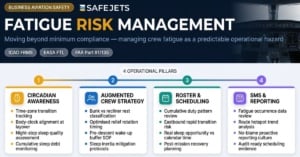
Why night stops and time-zone transitions create hidden fatigue risk ?
Fatigue on long-range business jets is shaped by two overlapping mechanisms: time awake and circadian displacement. Night stops may appear restorative on paper, yet a layover that occurs at an adverse body-clock time often produces poor sleep quantity and quality. A crew arriving in the early local morning after a westbound crossing may technically have a hotel rest period, but the sleep opportunity may be misaligned with the circadian window for effective recovery. The result is reduced alertness on the following duty, even when scheduling software shows legal rest.
International frameworks recognise this problem. ICAO Fatigue Risk Management guidance and the Standards and Recommended Practices in Annex 6 support a risk-based approach, while EASA flight time limitation rules and FAA Part 91/135 duty-rest concepts both acknowledge that acclimatisation, opportunity for sleep, sector timing, and in-flight rest conditions materially affect fatigue outcomes.
For business aviation operators, this means compliance should not be treated as a simple hours-based exercise. The operational question is whether the crew is likely to report for duty with adequate physiological recovery, not merely whether the minimum rest threshold has elapsed.
Night stops also introduce practical variables often overlooked in dispatch planning. Hotel transfer time, customs delays, meal timing, local noise, and short-notice schedule changes all erode effective rest. Within SAFEJETS compliance and safety oversight, these should be treated as fatigue precursors and captured through occurrence reporting, crew feedback, and trend monitoring. If a route regularly produces reduced sleep after arrival, the operator should reassess report times, planned layover length, and onward sector allocation.
Augmented crews: compliant manning is not the same as effective fatigue mitigation
Augmented crew operations are essential on many long-range business jet missions, but they only reduce fatigue if the relief strategy is properly engineered. Adding a third or fourth pilot does not automatically create resilience. The timing of relief breaks, the quality of the crew rest facility, cockpit workload peaks, and the need for briefing and cross-monitoring before descent all determine whether augmentation translates into meaningful alertness protection.
Regulatory authorities generally condition augmented operations on suitable rest facilities and defined in-flight rest opportunities. ICAO, EASA, and FAA frameworks all distinguish between bunk, seat, and recliner-type rest because the sleep obtained in each environment is not equivalent. In practice, operators should avoid scheduling the primary sleep period during the least biologically favourable segment for the assigned pilot whenever possible, and should ensure that the pilot returning from rest has sufficient recovery time before high-workload phases such as oceanic entry changes, complex arrival reprogramming, or low-visibility approach preparation.
A common weakness in business aviation is treating the augmented roster as a staffing solution rather than a fatigue-control measure. The more effective method is to define standard operating practices for crew rotation, minimum adaptation time after waking, controlled use of caffeine, and clear transfer-of-control discipline. A pilot awakened too close to top of descent may be legal and present, but still affected by sleep inertia. That risk should be explicitly addressed in SOPs, fatigue reporting forms, and commander decision-making guidance.
Within a modern SMS, fatigue data from augmented flights should be reviewed just as seriously as technical reliability data. Operators can correlate report times, sectors, rest-facility type, and fatigue reports to identify where the roster is compliant but fragile. Software-supported oversight is valuable here because it allows fatigue-related indicators to be linked with scheduling, occurrence management, and audit evidence in one traceable system.
How operators can implement a practical fatigue-control strategy ?
For long-range business jets, Fatigue Risk Management works best when it is embedded in daily operational control rather than handled as a policy document alone. Scheduling should consider circadian low periods, recent time-zone exposure, and the cumulative pattern of disrupted sleep, especially after consecutive night duties or rapid eastbound transitions. Crew planners should assess whether the rest period is a real sleep opportunity, not just a block of calendar time. Post-mission recovery should also be part of the plan, because Fatigue Risk Management often peaks on the subsequent duty rather than on the headline long-haul sector itself.
Commanders and flight operations managers should be encouraged to use Fatigue Risk Management reports proactively, without stigma and without treating every report as a disciplinary or inefficiency issue. Effective operators train crews to identify reduced alertness, micro-sleep risk, and cognitive slowing early, then connect those observations to operational mitigation such as delaying report, adjusting augmentation, extending layover, or replacing a sector. This aligns with ICAO FRMS principles even where a full formal Fatigue Risk Management System is not mandated by the applicable rule set.
For implementation, the most reliable controls are procedural consistency and documented evidence. Fatigue controls should appear in scheduling protocols, SOPs, training syllabi, and internal audit criteria. When authorities or clients review the operation, the operator should be able to show not only legal duty records but also how fatigue hazards from night stops, time-zone displacement, and augmented crews are identified, assessed, mitigated, and reviewed for effectiveness. That is where compliance and safety management converge.
In practical terms, operators should validate whether layovers actually permit restorative sleep, ensure augmented crew procedures include realistic pre-descent wake-up buffers, and use SMS data to identify recurring fatigue hotspots by route and duty pattern. When fatigue is managed as an operational risk instead of a scheduling afterthought, long-range business aviation becomes not only more compliant, but more stable and defensible.